Trust through
Proof.
Verification is not a separate command an agent may forget to run – the Double-Lock executes inside every mutation. diagnostics list is the standalone read on workspace health. Broader layers (policy checks, test orchestration) are planned, not implemented yet.
Synopsis
Two verification surfaces exist: the Double-Lock, which runs inside every mutation, and diagnostics list, the standalone read for a file or a workspace. One caveat travels with both: an LSP-clean result does not claim behavioural correctness.
weaver diagnostics list [--uri | --workspace] [FLAGS]
Surfaces
| Surface | Source | Description |
|---|---|---|
| diagnostics list | LSP | Compiler warnings and language-server errors for a file (--uri) or the whole workspace (--workspace). |
| the Double-Lock | Engine | Runs inside every mutation: Tree-sitter validates the staged result, LSP observes the complete proposed delta. Not optional, not skippable. |
| policy Planned | Sempai | Enforce architectural constraints and forbidden patterns via Sempai queries. |
| tests Planned | Runner | Orchestrate test suites and report results as structured output. |
The Verification Stack
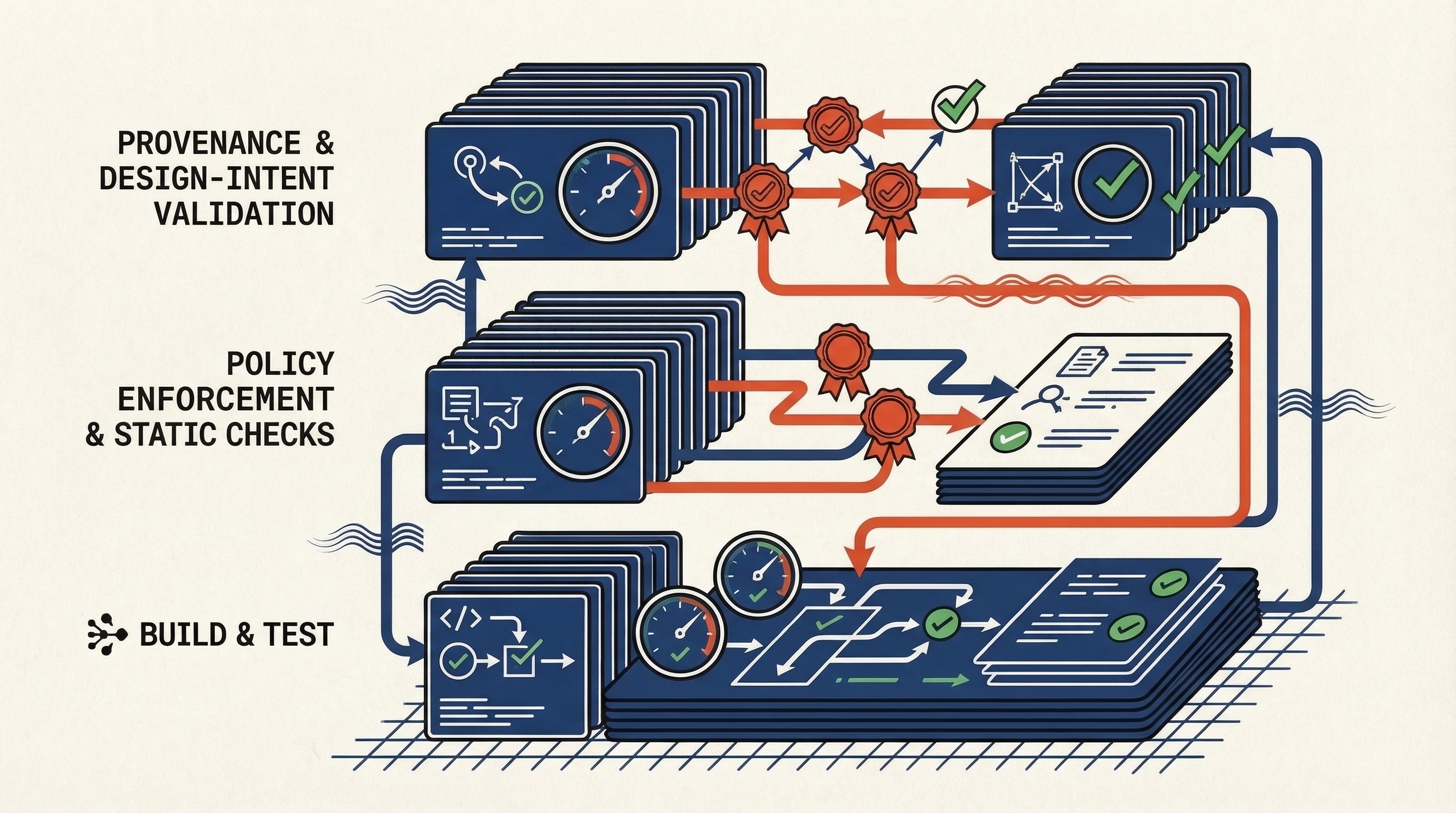
The Double-Lock and diagnostics list form the base layer. Policy enforcement and test orchestration are planned follow-on layers.
Diagnostics
Compiler warnings and LSP errors for any file or workspace with a supported language server.
Policy Enforcement
Architectural constraints and forbidden-pattern detection via Sempai queries.
Test Orchestration
Run test suites and report results as structured JSONL for CI gating.
The Double-Lock, In Detail
Every proposed change is staged into one workspace view and verified twice before commit. No path silently weakens this contract.
Syntactic lock
Tree-sitter parses the final staged content of every touched file. Structural breakage – unbalanced braces, truncated blocks – is refused before any semantic work runs.
Semantic lock
The language server observes the complete proposed delta and flushes diagnostics once per language. A missing semantic backend yields an explicit unavailable or inconclusive status under declared policy – never a silent pass.
The diagnostics delta
Post-mutation diagnostics are classified rather than dumped: introduced, severity-worsened, resolved, unchanged, or relocated. Concise deltas render inline; the complete set sits behind a bounded spool reference.
An LSP-clean result does not claim behavioural correctness. The locks prove the change parses and type-checks; the test suite still owns behaviour.
Planned: Policy Rules
PlannedA future policy surface will combine standard linters with custom Sempai queries to enforce architectural constraints. The schema below is illustrative.
- Block dangerous functions or imports
- Enforce type hints and documentation standards
- Require specific test coverage thresholds
"Verification is not just about catching bugs; it is about ensuring the AI acts within the boundaries of the system's design philosophy."
version: "1.0"
rules:
  # Enforce security patterns
  - name: "no-raw-sql"
    severity: "error"
    query: "sempai: pattern: sql_query($X) where $X is string_literal"

  # Ensure testing standards
  - name: "test-coverage"
    severity: "warning"
    check: "coverage > 85%"
Output & Integration
CLI Output Modes
Results go to stdout; progress and warnings go to stderr. With --json, the stable machine contract streams verbatim; without it, the human renderer applies, with --limit and truncation markers keeping large workspaces bounded.
$ weaver diagnostics list --json --uri file:///src/lib.rs

// stable machine contract (--json)
{"diagnostics":[{"line":12,"column":5,"message":"unused variable `x`"}]}
Human Mode
Point at a file URI to pull every diagnostic the language server reports. Human-readable output is the default when stdout is a TTY, so recognised diagnostics render with source context instead of raw JSON.
$ weaver diagnostics list --uri file:///src/lib.rs

src/lib.rs
  --> 12:5
   |
12 | let x = 42;
       ^ unused variable `x`
Ready to secure your agents?
Learn how the sandbox keeps execution safe.